What SEC Regulation S-P Requires: The Safeguards and Disposal Rules for Investment Advisers and Broker-Dealers
Regulation S-P (17 CFR Part 248, Subpart A) is the Securities and Exchange Commission's core privacy and data-security rule for broker-dealers, registered investment companies, SEC-registered investment advisers, and SEC-registered transfer agents. It requires these "covered institutions" to maintain written policies that protect and properly dispose of customer information, and, since amendments the Commission adopted in May 2024, to run a formal incident response program that notifies affected customers of certain breaches within 30 days. Larger entities must comply with the amendments by December 3, 2025; smaller entities have until June 3, 2026.
Key takeaways
- Regulation S-P covers SEC-registered broker-dealers, registered investment companies, SEC-registered investment advisers, and transfer agents registered with the SEC or another regulator. State-registered advisers are not covered.
- The original rule has two parts, both still in force: the Safeguards Rule (written policies protecting customer information) and the Disposal Rule (proper disposal of consumer report information), codified at 17 CFR 248.30(a)-(b).
- The May 2024 amendments add a mandatory incident response program, a customer-notification deadline of "as soon as practicable, but not later than 30 days," and service-provider oversight duties, including a 72-hour upstream breach notice from vendors.
- Notification is required only for breaches involving "sensitive customer information," a narrower category than the "customer information" the Safeguards Rule otherwise protects.
- Compliance dates are staggered by entity size: December 3, 2025 for larger entities, June 3, 2026 for smaller ones.
Who does Regulation S-P apply to?
Regulation S-P defines a "covered institution" as "any broker or dealer, any investment company, and any investment adviser or transfer agent registered with the Commission or another appropriate regulatory agency" (17 CFR 248.30(d)(3)). In practice that means SEC-registered broker-dealers (including funding portals), registered investment companies, SEC-registered investment advisers, and transfer agents registered with the SEC or another regulator.
Transfer agents are a recent addition to the full rule. Before the 2024 amendments, they were subject only to the Disposal Rule's requirement to properly dispose of information. The amendments extended the complete Safeguards Rule, including the incident response and notification requirements, to transfer agents as well.
State-registered investment advisers fall outside Regulation S-P entirely. Depending on their business, they may instead be covered by the FTC Safeguards Rule or by state privacy and data-security laws.
What does Regulation S-P actually require?
Regulation S-P's substantive requirements fall into three groups: the original Safeguards Rule, the original Disposal Rule, and the obligations the SEC added in May 2024.
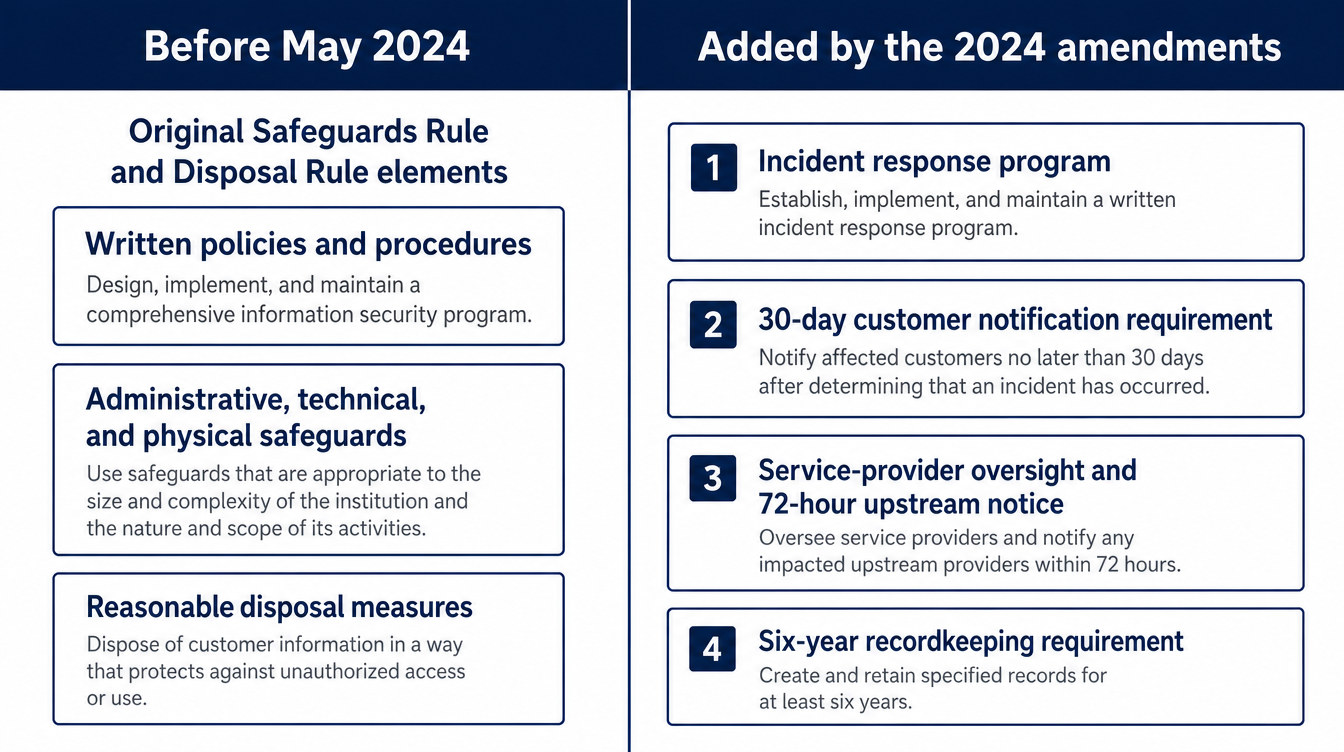
| Provision | What it requires | Added by |
|---|---|---|
| Safeguards Rule, 17 CFR 248.30(a)(1)-(2) | Written policies and procedures addressing administrative, technical, and physical safeguards for customer information, reasonably designed to protect its security and confidentiality and guard against unauthorized access | Original 2000 rule |
| Disposal Rule, 17 CFR 248.30(b)(1) | Reasonable measures to protect against unauthorized access to or use of consumer and customer information when disposing of it | Original rule, extended to transfer agents in 2004-05 |
| Incident response program, 17 CFR 248.30(a)(3) | A program to detect, respond to, and recover from unauthorized access to customer information, including notification procedures | May 2024 amendments |
| Customer notification, 17 CFR 248.30(a)(4) | Notice to affected individuals as soon as practicable, and no later than 30 days, when sensitive customer information is or is reasonably likely to have been accessed without authorization | May 2024 amendments |
| Service-provider oversight, 17 CFR 248.30(a)(5) | Due diligence and monitoring of service providers, plus a contractual requirement that they notify the covered institution within 72 hours of a breach | May 2024 amendments |
| Recordkeeping, 17 CFR 248.30(c) | Written records documenting compliance, generally retained for at least six years | May 2024 amendments |
The rule's own language on the incident response program is worth quoting directly: covered institutions must maintain "a program reasonably designed to detect, respond to, and recover from unauthorized access to or use of customer information, including customer notification procedures" (17 CFR 248.30(a)(3)). The program is a required component of the written policies the Safeguards Rule already demands. It isn't optional.
What counts as "sensitive customer information"?
The Safeguards Rule's baseline protections apply to "customer information" broadly: any record containing nonpublic personal information about a customer, whether from the institution's own client or shared by another financial institution. The notification requirement, though, only triggers for a narrower category: "sensitive customer information," defined as "any component of customer information alone or in conjunction with any other information, the compromise of which could create a reasonably likely risk of substantial harm or inconvenience to an individual identified with the information" (17 CFR 248.30(d)(9)).
The rule lists examples: Social Security numbers, driver's license and passport numbers, biometric records, and account numbers or usernames combined with a password, security question answers, or date of birth. An exposed account number by itself is customer information. That same account number paired with a password or Social Security number is sensitive customer information, and its compromise can trigger the 30-day notification clock.
How does Regulation S-P apply to sending and storing files?
Regulation S-P is technology-neutral. It never names a required encryption standard or software product, only the outcome: customer information has to be protected, and its disposal has to be handled with reasonable care. In practice, that outcome is hardest to meet in two everyday situations: a one-off exchange of a sensitive document, and an ongoing need to receive files from clients.
For a single transfer, such as a scanned account statement, wire instruction, or tax ID number, email and chat threads leave a permanent, often unencrypted copy sitting in multiple inboxes indefinitely. One way to reduce that exposure for a one-off share is a one-time encrypted link, such as a SparkVault (sparkvault.com) Spark, which limits a file or piece of text to a single read before it deletes itself. An encrypted email service or a client portal with a one-time download link can serve the same purpose.
For recurring exchanges, such as a client sending documents into your firm every quarter, a client upload link into an encrypted storage account avoids both the inbox problem and the need to email files back and forth. A secure client portal with role-based access is a vendor-neutral way to achieve the same result.
When do you have to notify customers?
The rule requires customer notification "as soon as practicable, but not later than 30 days, after becoming aware that unauthorized access to or use of customer information has occurred or is reasonably likely to have occurred" (17 CFR 248.30(a)(4)(iii)).
Notice is not automatic for every incident. It is required unless the institution determines, after a reasonable investigation, that the information "has not been, and is not reasonably likely to be, used in a manner that would result in substantial harm or inconvenience" to the individual. That determination has to be documented. An assumption won't do.
The required notice must include, per 17 CFR 248.30(a)(4)(iv):
- A description of the incident and the type of information involved
- The date or date range of the incident, if reasonably determinable
- Contact information, including a named office
- A recommendation to review account statements and report suspicious activity
- An explanation of fraud alerts and a recommendation to obtain a free credit report
- Information on reporting to the FTC through identitytheft.gov
A limited delay mechanism exists for law enforcement or national security reasons, requiring a written determination from the Attorney General.
What are the compliance dates for larger vs. smaller entities?
The amendments took effect August 2, 2024, but compliance dates are staggered by entity size.
| Entity type | Threshold for "larger entity" | Compliance date |
|---|---|---|
| Registered investment companies | Net assets of $1 billion or more, together with related investment companies, as of the most recent fiscal year-end | December 3, 2025 |
| SEC-registered investment advisers | $1.5 billion or more in assets under management | December 3, 2025 |
| Broker-dealers | Not a "small entity" under the Securities Exchange Act for Regulatory Flexibility Act purposes | December 3, 2025 |
| Transfer agents | Not a "small entity" under the Securities Exchange Act for Regulatory Flexibility Act purposes | December 3, 2025 |
| All other covered institutions | "Smaller entities" below the above thresholds | June 3, 2026 |
A smaller RIA is not exempt from Regulation S-P. It just has a later date to build out the same written policies, incident response program, and notification procedures that larger firms must already have in place. As of this writing, FINRA's compliance reminders confirm these dates remain in effect, though trade groups have asked the SEC for extensions. Check sec.gov directly for any updated order before relying on a specific date.
Common misconceptions about Regulation S-P
- "The 30-day clock starts at the breach." It starts when the institution becomes aware that unauthorized access occurred or is reasonably likely to have occurred, and the standard is "as soon as practicable," not a flat 30-day window.
- "Every incident requires notice." Notice is required only for incidents involving sensitive customer information, and only if the institution cannot document a reasonable determination that the information won't be used to cause substantial harm.
- "Small RIAs are exempt." They get a later compliance date based on size thresholds. The rule's substance still applies to them.
- "This is the same as the FTC Safeguards Rule." Both implement the Gramm-Leach-Bliley Act's safeguards mandate, but they're separate rules enforced by different regulators, covering different kinds of entities.
- "Outsourcing to a vendor shifts the compliance burden." The rule keeps the notification obligation with the covered institution even if a service provider is contractually delegated to send notices on its behalf.
How should compliance teams prepare?
Building or updating a written policy for the 2024 amendments generally involves:
- Scope determination. Confirm which compliance date applies by checking your firm's assets under management, net assets, or small-entity status under the Exchange Act, and document the determination.
- Policy updates. Fold the incident response program's three required elements (assess, contain, notify) into your existing written information security program. There's no need to draft a separate document from scratch.
- Service-provider oversight. Review vendor contracts for due diligence and monitoring provisions, and confirm contracts require vendors to notify your firm within 72 hours of a breach affecting a customer information system they maintain.
- Recordkeeping. Retain records documenting compliance, including incident investigations and notices, for at least six years, with the first two years in an easily accessible location.
- Board and management reporting. Establish a reporting line so the incident response program's findings, including any no-notice determinations, reach compliance leadership and, where appropriate, the board.
How Regulation S-P relates to Regulation S-ID and the FTC Safeguards Rule
These three rules are often confused but are legally distinct. Regulation S-ID (17 CFR Part 248, Subpart C) is a separate identity-theft red flags rule requiring covered broker-dealers, advisers, and investment companies with "covered accounts" to maintain a written program to detect and respond to identity theft warning signs; it does not govern general data safeguards or breach notification the way Regulation S-P does. The FTC Safeguards Rule (16 CFR Part 314) implements the same Gramm-Leach-Bliley Act mandate as Regulation S-P, but for nonbank financial companies the SEC does not regulate, such as mortgage brokers and certain tax preparers. None of these three rules substitute for the others, and a firm subject to Regulation S-P should not assume compliance with one satisfies the requirements of another.
Frequently asked questions
Does Regulation S-P apply to state-registered investment advisers?
No. Regulation S-P applies only to broker-dealers, registered investment companies, investment advisers, and transfer agents registered with the SEC or another appropriate regulatory agency. State-registered advisers fall outside its scope and may instead be subject to the FTC Safeguards Rule or state law.
What's the deadline for notifying customers after a breach?
As soon as practicable, but not later than 30 days after the institution becomes aware that unauthorized access to or use of customer information occurred or is reasonably likely to have occurred, for breaches involving sensitive customer information (17 CFR 248.30(a)(4)(iii)).
Does using an encrypted file-sharing tool make my firm compliant with Regulation S-P?
No single tool satisfies the rule. Regulation S-P requires written policies covering safeguards, disposal, an incident response program, and notification procedures. Encryption and one-time delivery tools can support the safeguards and disposal requirements, but they don't replace the written program itself.
What's the difference between Regulation S-P and the FTC Safeguards Rule?
Both implement the Gramm-Leach-Bliley Act's safeguards mandate, but Regulation S-P covers SEC-registered broker-dealers, investment companies, advisers, and transfer agents, while the FTC Safeguards Rule covers nonbank financial companies the SEC doesn't regulate. They're enforced by different agencies and shouldn't be treated as interchangeable.
Does Regulation S-P replace our existing written information security program?
No. Most firms fold the rule's required elements (the incident response program, notification procedures, and service-provider oversight) into their existing written information security program and skip drafting a separate document.
What happens if a breach doesn't involve sensitive customer information?
Notification isn't automatically required. It applies specifically to incidents involving sensitive customer information, unless the firm determines and documents that the information isn't reasonably likely to cause substantial harm or inconvenience if misused.
This article is general information and isn't legal advice. Check with your counsel or compliance advisor about your situation.
Sources
- 17 CFR 248.30: Procedures to safeguard customer records and information; disposal of consumer report information (Cornell LII)
- eCFR: 17 CFR Part 248, Regulation S-P
- SEC Final Rule Release Nos. 34-100155; IA-6604; IC-35193 (May 16, 2024)
- SEC Press Release 2024-58: SEC Adopts Amendments to Regulation S-P
- Federal Register: Regulation S-P: Privacy of Consumer Financial Information and Safeguarding Customer Information (June 3, 2024)
- SEC Small Entity Compliance Guide: Regulation S-P Amendments
- FINRA Cybersecurity Advisory: SEC Amends Regulation S-P
- FINRA: SEC Regulation S-P Compliance Date Reminder
Send the next sensitive document as a one-time Spark, free, instead of attaching it to an email.