What the FTC Safeguards Rule Requires: A Compliance Guide for Small Financial Businesses
The Federal Trade Commission (FTC) Safeguards Rule, formally the Standards for Safeguarding Customer Information at 16 CFR Part 314, requires most non-bank financial businesses (including tax preparers, mortgage brokers, auto dealers and debt collectors) to maintain a written information security program covering access controls, encryption, employee training, vendor oversight and incident response. If you collect or handle customer financial information and aren't already regulated by a banking agency or the Securities and Exchange Commission (SEC), you're almost certainly covered, regardless of your size. A narrow exception removes four specific requirements for businesses that maintain information on fewer than 5,000 consumers, but it does not exempt anyone from the rule entirely.
Key takeaways
- The rule covers any "financial institution" under the Gramm-Leach-Bliley Act (GLBA) that the FTC oversees (as opposed to another regulator). That list includes tax preparers, mortgage brokers, auto dealers, collection agencies and other finance-adjacent businesses.
- Section 314.4 lists the required elements of a Written Information Security Program (WISP): a designated Qualified Individual, a risk assessment, specific technical safeguards, monitoring and testing, training, vendor oversight, an incident response plan and board reporting.
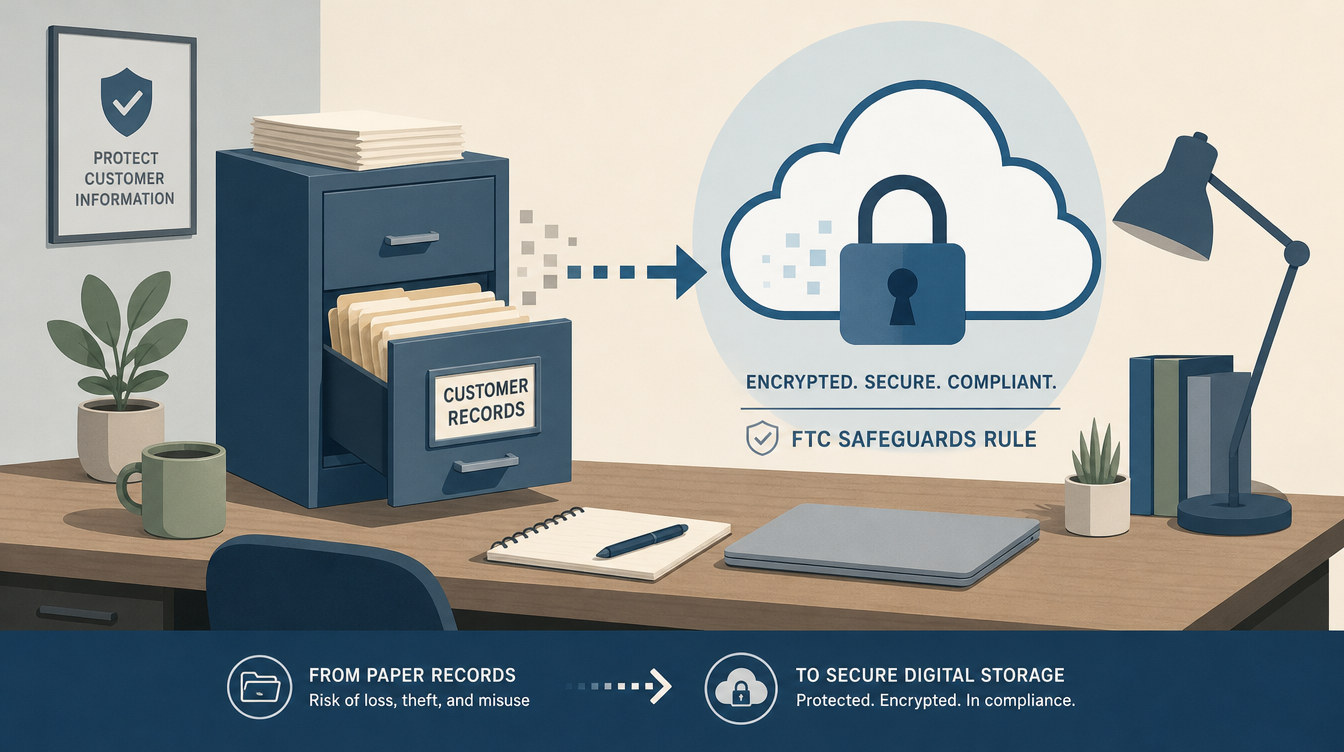
- Customer information must be encrypted in transit and at rest unless your Qualified Individual approves and documents an equally effective alternative (16 CFR 314.4(c)(3)).
- If you maintain information on fewer than 5,000 consumers, four specific provisions don't apply to you. The rest of the rule still does (16 CFR 314.6).
- A 2022 amendment to the rule also requires covered businesses to notify the FTC when a breach affects 500 or more consumers' unencrypted information (16 CFR 314.4(j)).
Who the Safeguards Rule applies to
The Safeguards Rule implements part of the Gramm-Leach-Bliley Act (GLBA) and applies to any "financial institution" the FTC regulates: a business "significantly engaged" in financial activities that isn't already supervised by a banking regulator or registered with the SEC. The FTC's own guidance lists examples that routinely surprise owners who don't think of themselves as "financial": mortgage lenders and brokers, payday lenders, finance companies, account servicers, check cashers, wire transfer companies, collection agencies, credit counselors, tax preparation firms, non-federally insured credit unions, and investment advisers not required to register with the SEC (FTC, "FTC Safeguards Rule: What Your Business Needs to Know").
Motor vehicle dealers are covered too, because arranging financing or leases for customers counts as a financial activity under GLBA, even when the dealer isn't the one extending the credit. Revenue and employee count don't decide coverage. What decides it is whether you handle "customer information," defined broadly in 16 CFR 314.2 as records containing nonpublic personal information about a consumer who has a relationship with you for a financial product or service.
What the rule actually requires, provision by provision
| Provision | Plain English | What to do |
|---|---|---|
| Qualified Individual (314.4(a)) | One named person (employee, affiliate or outside contractor) is responsible for your security program. | Put a name and title on the WISP. A small firm can use an outside IT or compliance contractor. |
| Risk assessment (314.4(b)) | A written assessment of foreseeable risks to customer information, how you'll evaluate them, and how you'll address them. | Document where customer data lives (email, shared drives, software, paper files) and what could go wrong with each. |
| Access controls and data inventory (314.4(c)(1)-(2)) | Limit who can see customer information to people who need it, and know where that information is stored. | Turn off shared logins, restrict folder permissions, and keep an inventory of systems holding customer data. |
| Encryption (314.4(c)(3)) | Customer information must be encrypted in transit and at rest, unless your Qualified Individual documents an equally effective alternative. | Encrypt stored client files and avoid sending unencrypted attachments by email. |
| Multi-factor authentication (MFA) (314.4(c)(5)) | Anyone accessing customer information needs more than a password, or an equivalent control. | Turn on MFA for email, cloud storage and any system holding customer records. |
| Secure disposal (314.4(c)(6)) | Dispose of customer information securely no later than two years after it's last used, unless you have a legal or business reason to keep it. | Set a retention schedule and a shredding or secure-deletion process. |
| Monitoring and testing (314.4(d)) | Test your safeguards continuously, or run annual penetration testing plus vulnerability assessments every six months if you lack continuous monitoring. | Schedule testing now if you don't already have continuous monitoring tools in place. |
| Training (314.4(e)) | Train staff on security risks and keep security personnel current. | Run annual security-awareness training and document attendance. |
| Service provider oversight (314.4(f)) | Choose vendors capable of safeguarding customer information, put safeguard requirements in contracts, and periodically assess them. | Review the security practices of any software vendor that touches customer data, including file storage and delivery tools. |
| Incident response plan (314.4(h)) | A written plan for responding to a security event, with defined roles and a post-incident review. | Draft a short plan covering who's notified, who decides, and how you document the response. |
| Annual report to the board (314.4(i)) | The Qualified Individual reports in writing, at least annually, to the board or a senior officer. | Put a short written report on the calendar, even if "the board" is just the owner. |
| Breach notification to the FTC (314.4(j)) | Notify the FTC after discovering a breach involving unencrypted information on 500 or more consumers, a requirement added by a 2022 amendment. | Build FTC notification into your incident response plan, with a 30-day clock in mind. |
| Small-entity exception (314.6) | If you maintain information on fewer than 5,000 consumers, 314.4(b)(1), (d)(2), (h) and (i) don't apply. | Confirm your consumer count and document which provisions you're relying on the exception for. |
How the rule applies to sending and storing files
Most of the file-handling risk under the Safeguards Rule comes down to one provision: encrypt customer information in transit and at rest, or document why an alternative control is just as effective (16 CFR 314.4(c)(3)). In practice, that means a tax preparer emailing a client's W-2 as an unencrypted attachment, or a mortgage broker storing loan files on a shared drive with no access controls, is exactly the kind of gap an examiner or plaintiff's counsel looks for.
The rule doesn't name a specific product. Reasonable safeguards for a one-off send (a wire instruction, a Social Security number, a signed disclosure) can include a one-time encrypted link that deletes itself after the recipient opens it, a client portal with its own login, or encrypted email with a password the client already has. SparkVault (sparkvault.com) is one option for the one-time case: a Spark sends text, a file or a link once, encrypted end to end, and it's gone after the recipient reads it or the delivery window expires, which also limits how long the data sits somewhere a later breach could expose it.
For files you keep on hand over time (client tax returns, signed loan documents, board decks), the same encryption-at-rest requirement applies to wherever they're stored. That could be a SparkVault Vault, a client portal from your practice-management software, or an encrypted shared drive your existing vendor already provides.
Try it: Set up a client upload link so customers send documents directly into encrypted storage instead of email.
Common misconceptions
- "We're too small to be covered." The rule has no revenue or headcount threshold. If you handle customer financial information and aren't regulated elsewhere, you're covered. The only size-based relief is the narrow 314.6 exception described above.
- "The rule names a specific encryption standard." It doesn't. 16 CFR 314.4(c)(3) requires encryption or an equally effective, documented alternative; it doesn't mandate a particular algorithm or vendor.
- "Fewer than 5,000 consumers means we're exempt from the whole rule." The exception in 314.6 removes exactly four provisions: the written risk assessment, continuous monitoring or periodic testing, the written incident response plan, and the annual board report. Access controls, encryption, training and vendor oversight still apply.
- "GLBA is a bank thing." GLBA's safeguards provisions apply well beyond banks, to any business substantially engaged in financial activities, which is why tax preparers and auto dealers show up on the FTC's own list of covered businesses.
For compliance teams: scope, documentation and board reporting
For compliance, legal and IT leads at larger finance-adjacent firms, three things tend to matter most once a basic WISP is in place.
Scope and thresholds. Confirm whether your consumer count puts you over the 5,000 mark in 314.6. If it does, 314.4(b)(1), (d)(2), (h) and (i) all apply in full, so you'll want a risk assessment, a monitoring and testing cadence, an incident response plan and board reporting that can stand up to a records request.
Documentation and evidence. The written risk assessment, training logs, vendor contracts with security requirements, penetration test and vulnerability assessment results, and the annual report to the board are the artifacts an examiner or opposing counsel asks for first. Keep them dated and versioned.
Vendor oversight. Section 314.4(f) requires you to assess whether service providers, including any tool used to send, store or process customer files, maintain safeguards, and to put that requirement in the contract. That applies to file-storage and delivery tools the same way it applies to your core processing software.
Board reporting and other frameworks. The 314.4(i) report doesn't have to be elaborate, but it should cover the risk assessment's results, safeguard changes, service-provider arrangements and any incidents. If you're also subject to Internal Revenue Service (IRS) Publication 4557's data-security expectations for tax preparers, state breach-notification statutes, or National Association of Insurance Commissioners (NAIC) model requirements for insurance-adjacent work, fold those into your WISP and incident response plan so you aren't maintaining separate documents.
Frequently asked questions
Does the Safeguards Rule apply to a one-person tax prep business with no employees?
Yes. The rule applies based on the kind of customer information you handle. Staff size doesn't enter into it. A sole proprietor preparing returns is a "financial institution" under GLBA and needs a WISP, though the 314.6 exception may remove four specific requirements if you maintain information on fewer than 5,000 consumers.
How do I count "consumers" for the 5,000-consumer exception?
The rule counts consumers whose information you maintain, including former clients whose records you still hold, in addition to people you're currently serving. If you're close to the threshold, document your count and the method you used so you can show how you applied 16 CFR 314.6.
Is encryption actually required, or just recommended?
It's required. 16 CFR 314.4(c)(3) requires encryption of customer information both in transit and at rest, with one narrow exception: your Qualified Individual can approve and document a different control that's reasonably determined to be equally effective.
What happens if I don't comply?
The FTC can bring an enforcement action for violations of the Safeguards Rule, and a security incident involving unsafeguarded customer information can separately trigger state breach-notification obligations. Specific penalty amounts and enforcement outcomes vary by matter, so talk to counsel about your actual exposure. A general figure won't tell you much.
Do I need multi-factor authentication even as a small firm?
Yes, with a narrow exception. 314.4(c)(5) requires multi-factor authentication for anyone accessing customer information, unless your Qualified Individual approves an equally effective alternative in writing. That requirement is not on the list of provisions the small-entity exception removes.
Sources
- FTC, "FTC Safeguards Rule: What Your Business Needs to Know"
- 16 CFR Part 314, Standards for Safeguarding Customer Information (eCFR, current)
- Federal Register, "Standards for Safeguarding Customer Information" (Dec. 9, 2021)
This article is general information and isn't legal advice. Check with your counsel or compliance advisor about your situation.
Next time you need to send a wire instruction, a W-2 or a signed disclosure once, send it as a one-time Spark, free.
Last updated / Checked on October 13, 2026.
By the SparkVault Compliance Team. Reviewed by Dana Whitfield, CPA.
fact-checked and edited by the SparkVault Compliance Team.