FBI IC3 2024 Internet Crime Report: What Changed and What to Do About It
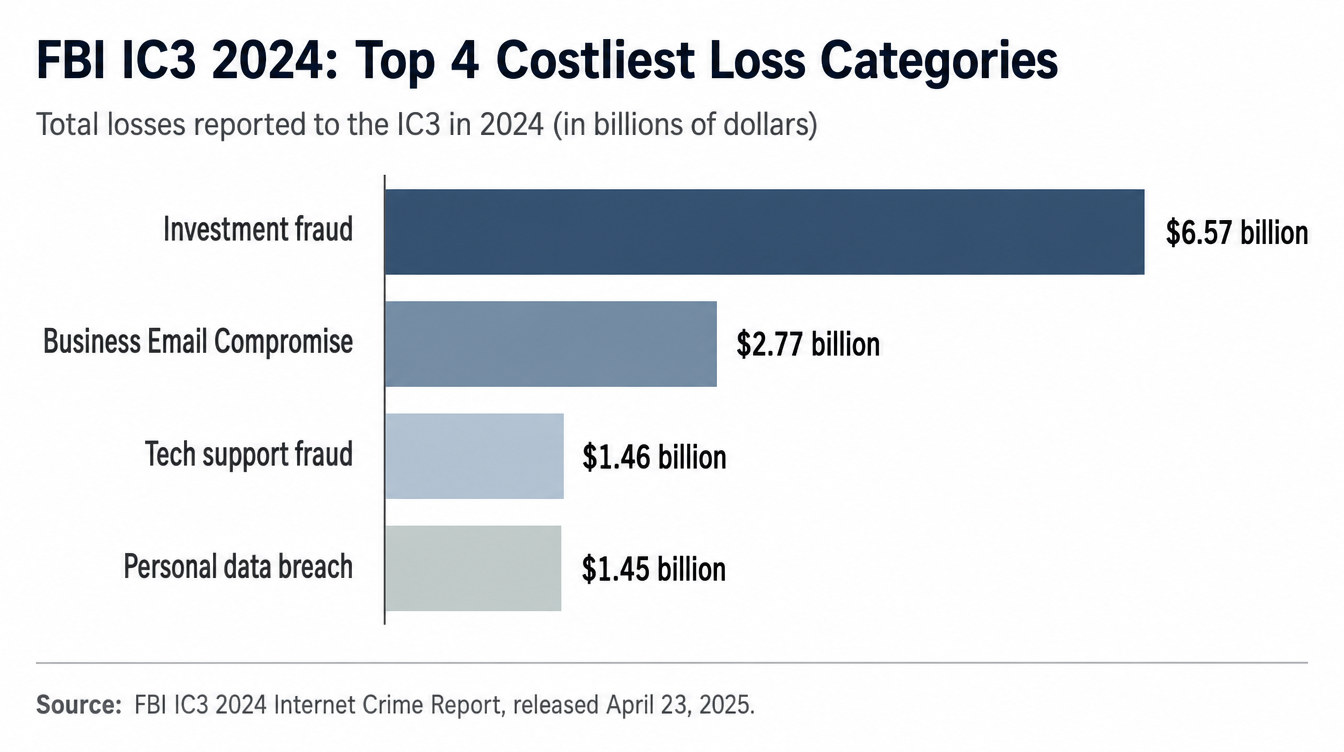
The FBI's Internet Crime Complaint Center (IC3) received 859,532 complaints in 2024 and recorded more than $16.6 billion in reported losses, a 33% increase from 2023, according to the FBI's April 23, 2025 release of the 2024 Internet Crime Report. Investment fraud, driven largely by cryptocurrency scams, was the costliest category at $6.57 billion. Phishing and spoofing remained the most frequently reported crime, with 193,407 complaints, and business email compromise (BEC) caused $2.77 billion in losses across 21,442 complaints.
This post is part of our ongoing coverage of annual cybercrime and breach reports.
Key takeaways
- IC3 logged 859,532 complaints in 2024 and more than $16.6 billion in reported losses, up 33% from 2023.
- Investment fraud, mostly crypto-related, was the costliest category: $6.57 billion in losses.
- Phishing/spoofing was the most-reported crime (193,407 complaints) but wasn't the costliest. BEC's $2.77 billion made it the second-highest loss category, even though it ranked seventh by complaint count.
- Adults 60 and older filed 147,127 complaints, up 46% from 2023, with losses approaching $5 billion.
- IC3 data is self-reported and covers only complaints filed directly with the bureau. It doesn't measure total U.S. cybercrime.
What is the IC3 report, and how does it collect data?
IC3 was established in May 2000 and has now collected roughly 9 million complaints over 25 annual reports. People submit complaints through a public form on ic3.gov, attesting under penalty of law that the information is accurate to the best of their knowledge. IC3 does not independently verify reported losses before publishing its aggregate statistics, and the center says it cannot respond directly to every submission.
That matters for how you read every number in this report. The figures below describe what victims told IC3. They aren't a confirmed or adjudicated count of crime. For how reporting obligations differ from a voluntary complaint like this, see our overview of state data breach notification laws.
What changed in 2024?
Of the 859,532 total complaints, 256,256 involved a reported dollar loss. The average loss among those complaints was $19,372. IC3 now handles more than 2,000 complaints per day on average, according to the FBI.
Which crimes cost the most money?
Dollar losses and complaint volume tell different stories. The table below ranks categories by reported loss, as stated in the FBI's release and the underlying report.
| Rank | Category | Reported 2024 losses | Complaints |
|---|---|---|---|
| 1 | Investment fraud | $6.57 billion | Includes 41,557 crypto investment fraud complaints at $5.8 billion |
| 2 | Business email compromise (BEC) | $2.77 billion | 21,442 |
| 3 | Tech support fraud | $1.46 billion | Not separately broken out in secondary coverage |
| 4 | Personal data breach | $1.45 billion | 64,882 |
Note: a small number of secondary write-ups cite personal data breach losses at $4.45 billion. This post uses $1.45 billion, which matches the majority of outlets that reviewed IC3's category breakdown. Confirm against the source PDF before citing this figure elsewhere.
Which crimes were reported most often?
Rank the categories by complaint count and the order changes. Phishing and spoofing led with 193,407 complaints, followed by extortion at 86,415 and personal data breach at 64,882. BEC, despite its $2.77 billion loss total, ranked only seventh by complaint count. Frequency and financial damage are separate questions. For specific steps, see our guide to preventing business email compromise.
Why did cryptocurrency losses jump so much?
Cryptocurrency was tied to $9.32 billion of 2024's total reported losses, a 66% increase from 2023, across roughly 150,000 complaints. Crypto ATM and kiosk scams alone generated 10,956 complaints and $246.7 million in losses, a 99% jump in complaint count.
The FBI's Operation Level Up, launched in early 2024, proactively contacted more than 4,300 suspected crypto investment fraud victims and says it helped prevent about $286 million in further losses. The bureau noted that 76% of contacted victims did not yet realize they were being scammed. For the warning signs behind these schemes, see our breakdown of cryptocurrency investment scam red flags.
What happened with elder fraud?
Adults 60 and older filed more complaints than any other age group (147,127, up 46% from 2023), with losses close to $5 billion. About 7,500 complainants in this group lost more than $100,000 each, averaging $83,000 per victim.
Crypto-related scams were especially costly to this group, accounting for more than $2.8 billion in losses, the highest of any age bracket. The most common scam types affecting people 60 and older were tech support fraud, romance scams, and cryptocurrency fraud.
What about ransomware and critical infrastructure?
IC3 identified 67 new ransomware variants in 2024. Reported ransomware complaints rose from 2,825 in 2023 to 3,156 in 2024, an increase of roughly 12%. The most frequently reported variants by complaint count were Akira, LockBit, RansomHub, FOG, and PLAY.
Reported ransomware dollar losses totaled $12.47 million. That figure excludes downtime, recovery costs, and reputational harm, so it understates the full cost to victims.
More than 4,800 complaints came from organizations in critical infrastructure sectors reporting a cyber threat, most commonly ransomware and data breaches. Within that group, healthcare and public health entities reported 238 ransomware incidents and 206 data breaches directly to IC3.
What are the limits of this data?
IC3 figures are self-reported and unverified before publication. They exclude crimes reported only to local police or an FBI field office without an IC3 complaint, unreported incidents, and collateral losses like lost business time or reputational damage.
The gap shows up in healthcare: more than 700 breaches were reported to the Department of Health and Human Services' Office for Civil Rights in 2024, while IC3 received only 206 data-breach complaints from the healthcare sector in the same period. Treat every number in this report as a floor on what actually happened.
What should you do this quarter?
The report's top categories map to a short checklist below. The mapping itself is ours (the FBI didn't publish it), but every control addresses a category the report names directly.
- Verify any payment or wire-instruction change out of band. Call a phone number you already had on file, never one listed in the email that requested the change. This directly addresses the $2.77 billion BEC caused in 2024.
- Stop sending credentials and account numbers over plain email or chat. A one-time link that expires after a single view, or a verified phone callback, doesn't leave a permanent copy sitting in an inbox. SparkVault (sparkvault.com) has Sparks for this: one-time secure delivery of text, files, or links up to 256,000 bytes, with an expiry window of 1 minute to 24 hours, gone after the first read.
Try it: Send it as a one-time Spark, free. Or use a verified callback if you'd prefer not to add a new tool.
- Treat unsolicited investment pitches, especially crypto, with default skepticism. Confirm any investment opportunity is registered with FINRA or the SEC before sending money. Investment fraud was 2024's costliest category at $6.57 billion.
- Brief anyone who handles payments on phishing and spoofing specifically. It's the largest complaint category by volume, even though it isn't the largest by dollar loss.
- Add a callback-verification step for urgent, emotionally charged financial requests if your business serves older clients or family members. Elder fraud losses approached $5 billion in 2024.
For larger teams: security, compliance and finance-ops
Document your out-of-band payment verification step in your finance standard operating procedures and test it in a tabletop exercise, since BEC remains a top-two loss category despite a slight year-over-year dip.
Review who has access to shared mail folders or drives containing vendor banking details and wire instructions. These are exactly the kinds of documents that show up in BEC and personal-data-breach complaints.
For recurring exchanges with outside counsel or vendors (contracts, client files, signed agreements), encrypted storage with sharing links and client upload replaces ad hoc email attachments. A SparkVault Vault is one option; a client portal with its own access controls is a vendor-neutral alternative. See our secure file storage page for details.
If you're a public company, confirm your existing incident-response and disclosure process already covers when a loss on the scale described in this report becomes material, and take that question to counsel. Don't guess.
Frequently asked questions
Does the IC3 report measure all U.S. cybercrime?
No. It counts complaints submitted directly to IC3, which excludes crimes reported only to local police or an FBI field office, unreported incidents, and non-financial collateral damage. The healthcare sector's reporting gap (far more breaches reported to HHS than to IC3 in 2024) shows the undercount.
What was the costliest crime category in 2024?
Investment fraud, at $6.57 billion in reported losses, driven largely by cryptocurrency scams. Crypto investment fraud alone accounted for $5.8 billion of that total across 41,557 complaints.
What was the most frequently reported crime?
Phishing and spoofing, with 193,407 complaints. That's more than double the next category, extortion, at 86,415 complaints. It's the most common complaint type, though it isn't the most expensive.
Is BEC still a major threat if losses fell slightly from 2023?
Yes. At $2.77 billion, BEC remained the second-highest loss category in 2024, and it's a real wire-fraud risk for any business that handles payments or vendor invoices.
What age group reported the highest losses?
Adults 60 and older filed the most complaints of any age group (147,127, up 46%) and reported losses close to $5 billion, with crypto scams the costliest category within that group.
Where can I check these figures myself?
Start with the FBI's April 23, 2025 press release and the underlying 2024 Internet Crime Report PDF published by IC3.
Sources
- FBI, "FBI Releases Annual Internet Crime Report," April 23, 2025
- FBI/IC3, "2024 Internet Crime Report" (PDF)
- Internet Crime Complaint Center (IC3)
- CyberScoop, "10 key numbers from the 2024 FBI IC3 report"
- HIPAA Journal, "Cybercrime Losses Increased by 33% in 2024 to $16.6bn"
- TRM Labs, "A Record-Breaking Year for Cybercrime"
- Nacha, "FBI's IC3 Finds Almost $8.5 Billion Lost to Business Email Compromise"
- CSO Online, "Ransomware the most pervasive threat to US critical infrastructure"
Last updated / checked on April 28, 2025. Figures were cross-checked against the FBI's press release and the primary IC3 report PDF at the time of publication. If IC3 issues a correction to any figure cited here, we'll update this page with a dated note.
When you need to send a password reset, a W-2, or a wire confirmation number to one person, one time, send it as a one-time Spark, free.
By the SparkVault Editorial Team.