Healthcare and Finance Data Breaches Monthly Roundup: HHS OCR Portal and State AG Filings
This month's roundup explains how to read the current entries on the HHS Office for Civil Rights (OCR) breach portal and state attorney general (AG) filings for healthcare and finance incidents. It isn't a cached list of specific breaches. The portal itself is a live, filterable database, so you need to pull this period's entries directly instead of relying on a summary. What stays constant between reporting periods is the set of notification deadlines, the ongoing OCR reporting backlog, and the current status of state AG databases you need to interpret those entries correctly. Those are what you'll find below.
Key takeaways
- The HHS OCR breach portal shows the date an organization submitted its report. That's different from the date it discovered the breach, and the two can be months apart.
- HHS has been working through a reporting backlog since a 43-day lapse in operations from October 1 to November 12, 2025; entries appearing this month may describe incidents from several months earlier.
- Notification deadlines vary sharply by jurisdiction and sector: 60 days under the Health Insurance Portability and Accountability Act (HIPAA), 30 days under new California law and under existing Washington and Texas law, and "immediately following discovery" under Maine law.
- Maine's public breach-notice database has been offline since June 12, 2026, after the AG's office found fraudulent filings impersonating other companies. Check its status before citing Maine entries.
- Finance-sector incidents mostly don't appear on a public, searchable portal the way healthcare incidents do; they surface through Securities and Exchange Commission (SEC) filings or confidential 36-hour notices to banking regulators.
How to read this period's HHS OCR entries
This roundup is part of our monthly data breach roundup series. The OCR portal (ocrportal.hhs.gov) lets you filter by Breach Submission Date and shows Name of Covered Entity, State, Covered Entity Type, Individuals Affected, Type of Breach, and Location of Breached Information. It does not show the discovery date. To find when an organization actually learned of a breach, you generally need the entity's own notification letter, which is sometimes linked from its website or attached to a state AG filing.
Treat the submission-date filter as the real limit of what you can know from the portal alone. If you want to cite a specific organization from this period, pull its row directly from the live tool and, where the discovery date matters, check the underlying notice. Don't assume the submission date reflects it.
Why do some months show so few breaches?
HHS operations lapsed for 43 days, from October 1 to November 12, 2025, and portal postings slowed sharply during and after that window. According to HIPAA Journal's compilation of OCR data (updated September 8, 2026, based on data obtained from OCR on September 4, 2026), zero breaches were posted for March 2026 as of three months after staff returned.
As of June 2026, the portal was still adding entries dated March 2026. A light month on the portal does not necessarily mean fewer breaches happened. It may mean a backlog is still clearing.
The same source reports 252 large healthcare breaches submitted to OCR between January 1 and April 30, 2026, about 9.5% fewer than the same period in 2025, and attributes the drop to the reporting backlog. It doesn't treat it as a confirmed decline in actual incidents.
Over the full history of the portal, October 21, 2009 through April 30, 2026, OCR had logged 7,670 large breaches, with Healthcare Providers accounting for the largest reporting-entity category, followed by Business Associates and Health Plans. HIPAA Journal notes that Business Associate breaches are likely undercounted by this method, because when a vendor is breached, each affected covered entity sometimes files its own separate report instead of the vendor filing once.
Why finance-sector breaches look different on paper
There is no HHS-style public portal for finance-sector incidents, because OCR's jurisdiction covers HIPAA-regulated protected health information and stops short of financial records. Public companies instead disclose material cybersecurity incidents under Item 1.05 of Form 8-K, a rule the Securities and Exchange Commission (SEC) adopted in July 2023 requiring disclosure within four business days of a materiality determination.
The SEC's Division of Corporation Finance clarified in a May 21, 2024 staff statement that this requirement applies only once materiality has actually been determined, and that many companies instead file a non-material Item 8.01 disclosure first.
Separately, under the federal 36-Hour Rule (12 CFR Part 304 Subpart C, effective May 1, 2022), banking organizations must notify their primary federal regulator within 36 hours of determining a notification incident occurred. That notice goes only to the regulator and never to the public, so it won't show up in a search the way an OCR or state AG filing does.
Notification deadlines by jurisdiction and sector
If your organization operates in more than one state, the deadline that matters is the shortest one that applies to you. Federal citations below use the Code of Federal Regulations (CFR); here's what's currently confirmed:
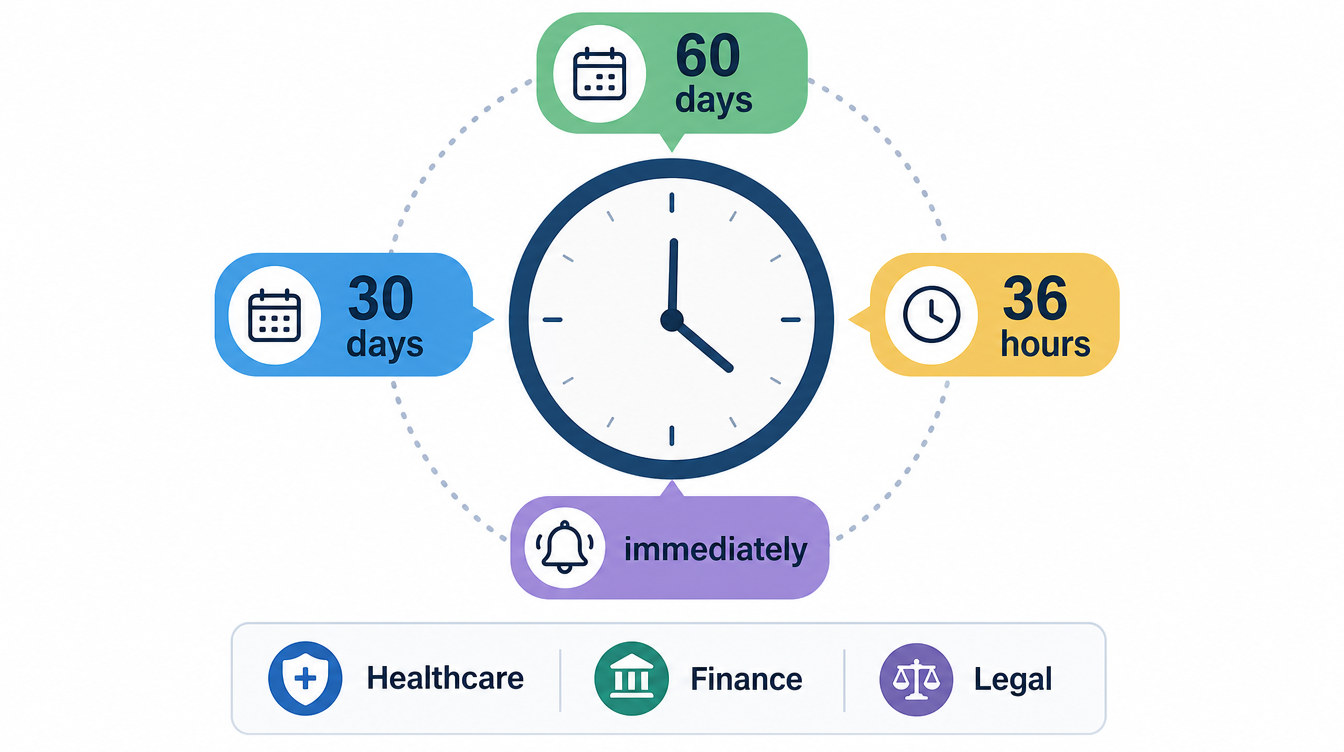
| Jurisdiction / sector | Deadline | Trigger |
|---|---|---|
| HIPAA (45 CFR §164.404(b)) | 60 calendar days | After discovery, for 500+ individuals; notice to individuals, media, and HHS |
| California (SB 446, effective Jan. 1, 2026) | 30 calendar days | After discovery; amends Civil Code §1798.82; AG notice also required for 500+ residents |
| Washington (RCW 19.255) | 30 days | After discovery, if more than 500 residents affected; AG notice required even where HIPAA- or bank-regulated entities are exempt from the individual-notice statute |
| Texas (effective Sept. 1, 2023) | 30 days (AG) / 60 days (individuals) | After determining a breach occurred, if 250+ Texas residents affected |
| Maine (Title 10 §1348) | "Immediately following discovery" | One of the stricter state standards |
| Banking regulators (12 CFR Part 304 Subpart C) | 36 hours | After determining a notification incident occurred; regulator-only, never public |
| SEC (Form 8-K Item 1.05) | 4 business days | After a materiality determination for public companies |
RCW = Revised Code of Washington. SB = Senate Bill.
A state AG portal is offline right now
Maine's public breach-notice database has been down since June 12, 2026. The Maine Attorney General's office said in a press release that it discovered fraudulent breach filings impersonating other companies, including VRChat and Discord, and took the database offline pending a procedural review, without stating a date for it to return. If you rely on Maine's site for this kind of tracking, check its current status before citing anything from it, and have a backup process ready (such as contacting the AG's consumer protection office directly) for when a public database goes dark without warning.
What to do now
- Map your own notification clock before an incident starts. During one is too late. If you handle data for people in California, Washington, Texas, and Maine, your real deadline is Maine's "immediately," and HIPAA's 60 days won't apply.
- Treat vendor and business-associate relationships as a concentrated point of exposure. A single vendor breach can trigger many separate covered-entity filings, and OCR's own category data suggests business-associate incidents are under-reported relative to their actual frequency. See our guide to vendor risk management for a fuller checklist.
- Document the discovery date the moment you learn of an incident, separately from the submission date you'll eventually file. Public portals only show the latter, and the distance between the two dates is exactly what regulators and plaintiffs' attorneys look at. Our incident response planning post covers how to log this internally.
- If you need to send a breach notice template, forensic report, or evidence package to a client, attorney, or regulator, don't let it sit in an email inbox indefinitely. Send it as a one-time Spark, SparkVault (sparkvault.com)'s one-time secure delivery for text, files, or links, or use any other time-limited, password-protected secure share.
- Build a habit of re-checking state AG portal availability before relying on it for this kind of research, given Maine's example this year.
For larger teams
For larger organizations, the practical work is less about watching headlines and more about keeping your incident-response runbook in step with the deadline table above, by jurisdiction and by sector, and reviewing it whenever a state changes its law. California's 30-day rule only took effect January 1, 2026, and more states are likely to tighten timelines. Few are likely to loosen them.
Procurement and audit teams working with healthcare or financial vendors should ask directly how the vendor documents its own discovery date internally, since that's the figure a public portal won't show you but a regulator will ask for. For background on the SEC disclosure rules referenced above, see our overview of SEC cybersecurity disclosure requirements.
FAQ
Does a breach entry appearing on the HHS OCR portal this month mean it happened this month?
Not necessarily. The portal shows the date an organization submitted its report to OCR. It doesn't show when the breach occurred or was discovered, and the current reporting backlog means entries dated this month can describe incidents from several months earlier.
Why don't financial-sector breaches show up on the HHS portal?
The OCR portal only covers HIPAA-regulated entities handling protected health information. Finance-sector incidents instead surface through state AG filings, SEC Item 1.05 or 8.01 disclosures for public companies, or confidential 36-hour notices to federal banking regulators, which aren't published.
How soon must an organization notify people after discovering a breach?
It depends on the jurisdiction and sector: 60 days under HIPAA, 30 days under California's new law and under Washington and Texas law, and "immediately following discovery" under Maine law. There is no single national deadline.
What should a vendor do if its breach affects clients in multiple states or sectors?
Public OCR data shows both patterns exist: sometimes a vendor files once, and sometimes each affected covered entity files its own separate report. Each affected organization may have an independent notification duty, so work this out with counsel. Don't assume.
Ready to stop attaching sensitive breach documentation to email threads? Send it as a one-time Spark, free.
Entries and figures referencing HIPAA Journal's compilation are date-stamped to that source's September 8, 2026 update; always verify current figures against the live HHS OCR portal and relevant state AG sites before citing a specific organization.
Sources
- HHS OCR, Breach Portal: Notice to the Secretary of HHS Breach of Unsecured Protected Health Information
- HHS.gov, Breach Notification Rule
- eCFR, 45 CFR Part 164 Subpart D
- California Attorney General, Search Data Security Breaches
- California SB 446 bill text
- Washington State Attorney General, Data Breach Notifications Directory
- Washington RCW 19.255.010
- Texas Attorney General, Data Breach Reporting
- Maine Attorney General, Statement on Abuse of Data Breach Reporting System (June 12, 2026)
- Maine Revised Statutes, Title 10 §1348
- SEC, Rules on Cybersecurity Risk Management, Strategy, Governance, and Incident Disclosure
- SEC Division of Corporation Finance, Statement on Item 1.05 (May 21, 2024)
- eCFR, 12 CFR Part 304 Subpart C
- HIPAA Journal, Healthcare Data Breach Statistics (secondary aggregator, updated Sept. 8, 2026)