NIST Adds HQC as a Backup Post-Quantum Encryption Standard: What It Means for Your Roadmap
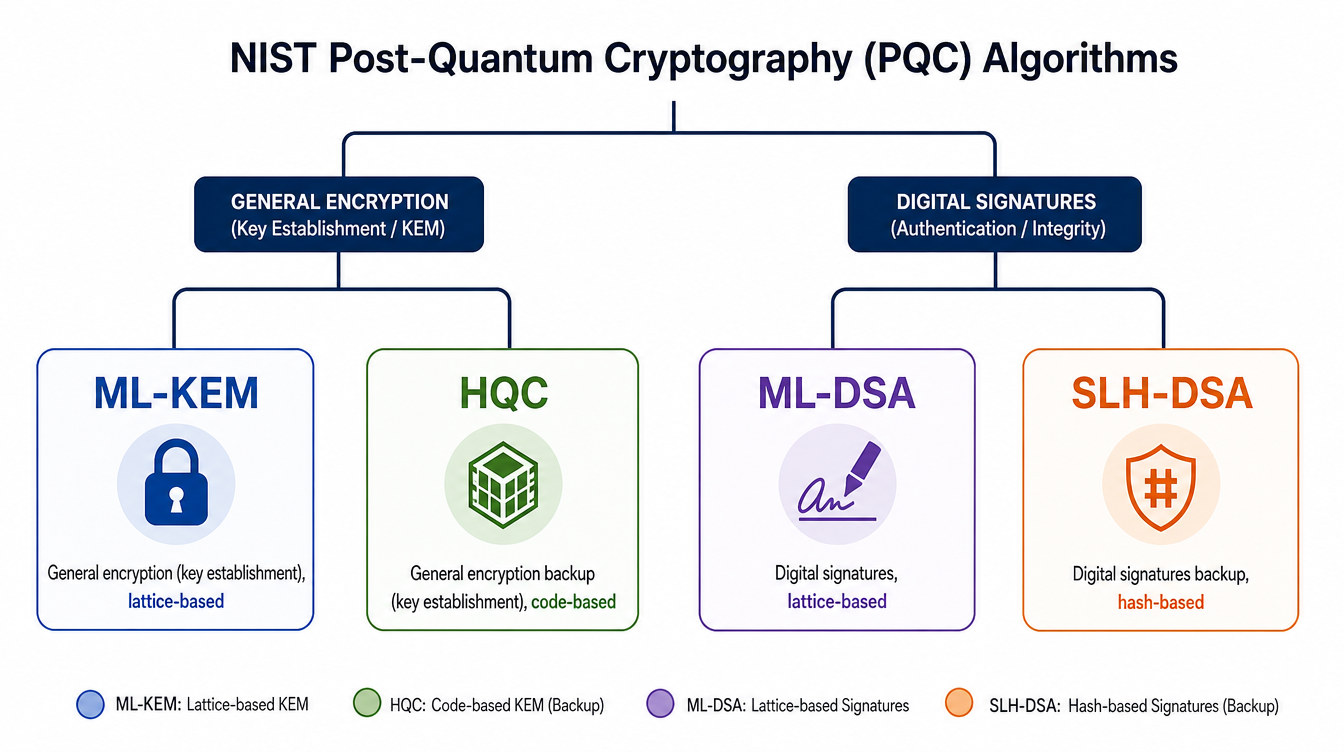
On March 11, 2025, the National Institute of Standards and Technology (NIST) selected HQC (Hamming Quasi-Cyclic) as a fifth post-quantum cryptography algorithm. HQC is a backup for ML-KEM (Module-Lattice-Based Key-Encapsulation Mechanism), the general-purpose encryption standard NIST finalized in August 2024, built on a different mathematical approach so a future weakness in one wouldn't necessarily break both. Nothing about this changes what organizations should be doing today: keep migrating to the three standards NIST already finalized, and keep your cryptographic inventory current.
Key takeaways
- NIST selected HQC on March 11, 2025 as a backup algorithm for ML-KEM. It won't replace ML-KEM.
- HQC uses error-correcting codes; ML-KEM uses structured lattices. The point is math diversity, so a weakness in one wouldn't sink both.
- ML-KEM (FIPS 203), ML-DSA (FIPS 204) and SLH-DSA (FIPS 205) remain the standards to use now, per NIST's own guidance.
- NIST expects a draft HQC standard for public comment roughly a year after the March 2025 announcement, with finalization expected in 2027.
- No current product can truthfully claim to support HQC as a finished, standardized feature yet.
What happened on March 11, 2025
NIST announced it had chosen HQC as the fifth algorithm in its post-quantum cryptography program, intended as a backup specifically for ML-KEM, which NIST calls "the main algorithm for general encryption." Both ML-KEM and HQC are key encapsulation mechanisms (KEMs), in NIST's words "a sort of first handshake between two parties that want to exchange confidential information." HQC was the only algorithm standardized out of four that NIST had kept under evaluation in a fourth review round.
This follows NIST's August 13, 2024 release of the first three finalized post-quantum standards, published as Federal Information Processing Standards (FIPS): FIPS 203 (ML-KEM, for general encryption, based on CRYSTALS-Kyber), FIPS 204 (ML-DSA, Module-Lattice-Based Digital Signature Algorithm, based on CRYSTALS-Dilithium), and FIPS 205 (SLH-DSA, Stateless Hash-Based Digital Signature Algorithm, based on Sphincs+ and using a different math approach than ML-DSA).
HQC extends that same hedging logic (a structurally different backup) from signatures to general encryption. For background on how these standards fit together, see our post-quantum encryption explainer, and for more on the primary standard's math, see how ML-KEM and lattice-based encryption work.
| Standard | Purpose | Math basis | Status (as of March 2025) |
|---|---|---|---|
| FIPS 203 (ML-KEM) | General encryption | Structured lattices | Finalized, August 2024 |
| FIPS 204 (ML-DSA) | Digital signatures | Structured lattices | Finalized, August 2024 |
| FIPS 205 (SLH-DSA) | Digital signatures (backup) | Stateless hash-based | Finalized, August 2024 |
| HQC | General encryption (backup to ML-KEM) | Error-correcting codes | Selected March 2025; draft for comment ~1 year later; final standard expected 2027 |
Why a second encryption algorithm matters
NIST's stated rationale is direct. Dustin Moody, the NIST mathematician who leads the post-quantum project, put it this way: "Organizations should continue to migrate their encryption systems to the standards we finalized in 2024. We are announcing the selection of HQC because we want to have a backup standard that is based on a different math approach than ML-KEM. As we advance our understanding of future quantum computers and adapt to emerging cryptanalysis techniques, it's essential to have a fallback in case ML-KEM proves to be vulnerable."
ML-KEM relies on the hardness of certain lattice problems. HQC relies on the hardness of decoding certain error-correcting codes, an unrelated area of math. If a cryptanalysis breakthrough ever weakened lattice-based schemes, an encryption standard that didn't depend on lattices at all would still be available to move to.
NIST used the identical logic once before, pairing SLH-DSA (hash-based) with ML-DSA (lattice-based) for signatures in 2024. HQC is the same hedge, applied to encryption.
There is a cost. NIST notes HQC is "a lengthier algorithm than ML-KEM and therefore demands more computing resources," but says its "clean and secure operation convinced reviewers it would make a worthy backup choice."
What this does and doesn't change for your roadmap
It doesn't change your near-term priorities. NIST's own CSRC project page states that ML-KEM, ML-DSA and SLH-DSA "will provide the foundation for most deployments of post-quantum cryptography" and that they "can and should be put into use now." HQC is not a finished standard. There is no FIPS number for it yet, no draft text published for public comment, and no production system should claim to support HQC as a completed feature today.
It does add a planning input. NIST expects to release a draft HQC standard for public comment roughly a year after the March 2025 announcement, followed by a 90-day comment period, with final standardization expected in 2027. That's a multi-year runway. It's useful for roadmap conversations and gives no reason to pause work on the standards already finalized.
What to do now
- Continue or start migrating systems to FIPS 203, 204 and 205. NIST has said there's no reason to wait.
- Keep a current cryptographic inventory: which algorithms protect which data flows, and where they live.
- Ask vendors about crypto-agility: whether their systems can add a new KEM like HQC later without a full re-architecture.
Related housekeeping: if you regularly send credentials, API keys or other sensitive one-off data to vendors or clients, keep that out of permanent email and chat threads. A one-time link, for example a SparkVault (sparkvault.com) Spark or any comparable one-time-delivery tool, does that regardless of which encryption algorithm sits underneath it.
When you're evaluating any provider's encryption roadmap (ours included), ask directly whether they already support the finalized 2024 standards and how they plan to evaluate HQC once it's finalized. Don't take a marketing claim at face value.
Implications for security and compliance teams
For most organizations, the action this quarter is unchanged: inventory your cryptography, migrate to the finalized standards where vendors support them, and don't treat HQC as something to deploy yet. It isn't available to deploy.
For larger teams: this is a good trigger to revisit vendor risk questionnaires and procurement language, including how you phrase requirements in a vendor security questionnaire. NIST's draft transition timeline, published as NIST IR 8547 (still an initial public draft and not finalized as of its last public status), outlines a plan to deprecate quantum-vulnerable algorithms like RSA and ECDSA around 2030 and disallow them by 2035, with high-risk systems moving earlier. Treat those dates as a draft planning signal when they feed into audit or procurement timelines. They aren't locked in.
Compliance teams tracking standards should also note NIST's parallel draft guidance, Special Publication 800-227, on recommendations for key encapsulation mechanisms generally.
Questions to ask vendors about PQ readiness
- Do you currently support the finalized FIPS 203, 204 and 205 standards?
- Is your implementation modular enough to add a new KEM, such as HQC, without a full re-architecture?
- Do you maintain a crypto inventory mapping algorithms to specific data flows?
- What is your plan for NIST's draft HQC standard once it's published for comment?
- How are you tracking NIST's draft transition timeline (IR 8547), understanding it remains a draft?
Frequently asked questions
Does HQC replace ML-KEM?
No. NIST states explicitly that ML-KEM "will remain the recommended choice for general encryption." HQC is a backup to be used if a future weakness is found in lattice-based schemes. It isn't meant as a near-term alternative.
When will HQC become a final standard?
NIST has said it expects to release a draft for public comment about a year after the March 2025 announcement, with finalization expected in 2027. NIST has not published a more specific date than that.
Do organizations need to do anything differently today because of HQC?
No. NIST's guidance remains that organizations should continue migrating to the three standards finalized in August 2024 (FIPS 203, 204, 205). HQC is a future diversification option, and there's no urgency to switch.
Why does NIST want a second general-encryption algorithm at all?
Because ML-KEM and HQC rely on different, unrelated hard math problems: structured lattices versus error-correcting codes. A future weakness discovered in one approach wouldn't automatically compromise the other, which gives organizations a fallback path.
Can a vendor legitimately claim to support HQC right now?
Not as a finished, standardized feature. There's no FIPS number or finalized specification for HQC yet. A vendor can reasonably say HQC is on its roadmap for evaluation once NIST publishes a draft and final standard.
Set up post-quantum-ready encrypted file storage and sharing.