Verizon's 2025 Data Breach Investigations Report (DBIR), published April 23, 2025, analyzed 22,052 security incidents and confirmed 12,195 data breaches, the most breaches the 18-year-old report has ever covered in one edition. Stolen or reused credentials and unpatched vulnerabilities were the two leading ways attackers got in, and the share of breaches involving a third party doubled to 30%. For most organizations, the report's clearest message is to patch edge devices and VPNs faster, cut down on reused passwords, and tighten how you track vendor access this quarter.
Key takeaways
- Verizon's 18th annual DBIR, published April 23, 2025, analyzed 22,052 security incidents and confirmed 12,195 breaches, the highest number of confirmed breaches in a single edition.
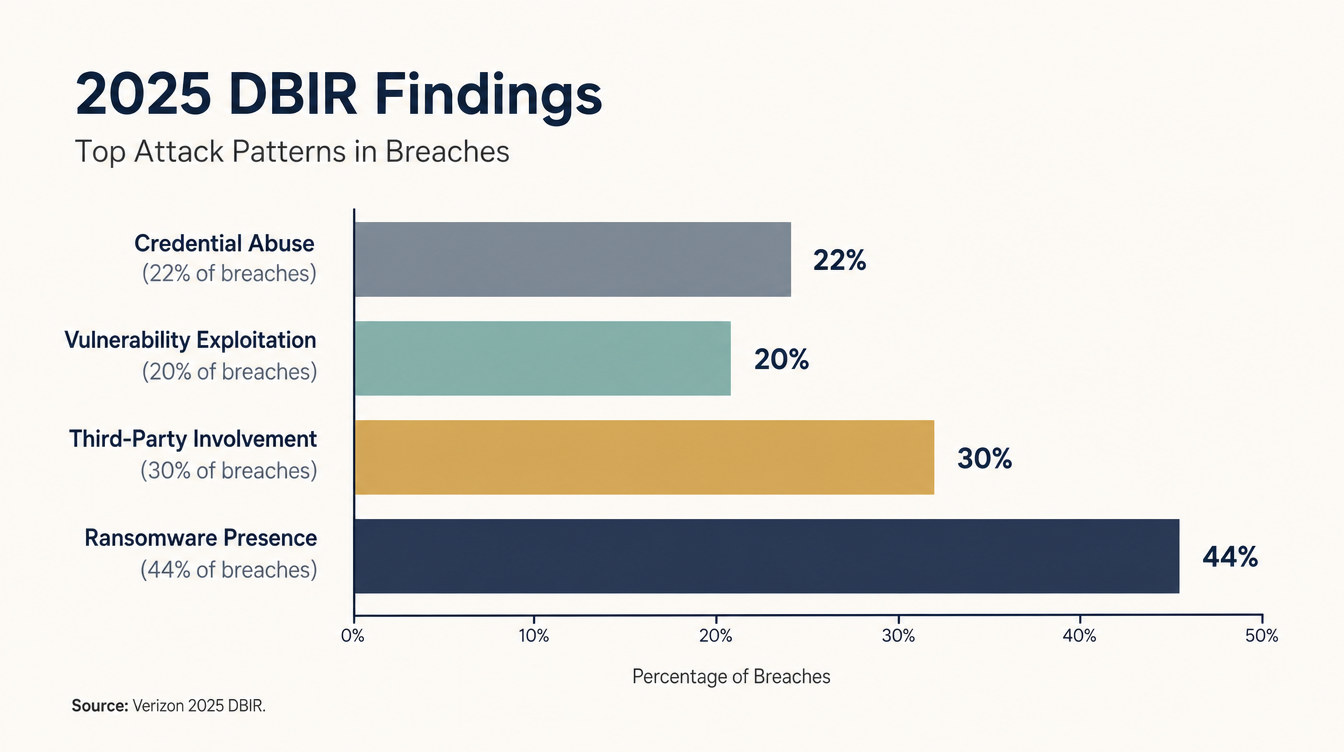
- Credential abuse was the largest initial access vector (22% of breaches); exploitation of vulnerabilities followed at 20% and grew 34% year over year.
- Breaches involving a third party doubled to 30%, up from 15% the year before.
- Ransomware appeared in 44% of all breaches overall, but in 88% of breaches at small and midsize businesses versus 39% at large organizations.
- In infostealer logs, the median user had only 49% of their passwords distinct across services. Roughly half were reused.
What is the DBIR, and what did the 2025 edition cover?
Verizon Business publishes the Data Breach Investigations Report (DBIR) every spring, drawing on its own incident caseload plus data contributed by partner organizations worldwide. The 2025 edition is the 18th, covers incidents from November 1, 2023 through October 31, 2024, and pulls from 139 countries, according to Verizon's April 23, 2025 press release.
The report draws a line between two terms often used interchangeably elsewhere. An incident is a security event that compromises the integrity, confidentiality or availability of an information asset. A breach is an incident that results in the confirmed disclosure of data to an unauthorized party; potential exposure alone doesn't count. That distinction is why the 2025 dataset shows 22,052 incidents but only 12,195 confirmed breaches: most reviewed events didn't meet the higher bar of confirmed disclosure.
Verizon's own methodology notes that the dataset isn't a random sample of every breach worldwide. Contributor coverage varies by industry, region and incident type from year to year. Keep that in mind before treating any single percentage as a precise, universal figure; most are better read as directional findings. This explainer continues our coverage of major annual security reports, alongside our breakdown of the FBI's 2024 IC3 report.
What changed in the 2025 DBIR?
Credential abuse and vulnerability exploitation led initial access
Among confirmed breaches where Verizon could identify how attackers got in, credential abuse (using stolen or reused login credentials) was the largest vector, present in 22% of breaches. Exploitation of vulnerabilities followed at 20%, but it grew faster than any other vector, up 34% year over year. The edge-device and VPN findings below help explain why.
| Initial access vector | Share of breaches | Year-over-year change |
|---|---|---|
| Credential abuse (stolen or reused logins) | 22% | Not reported as a single year-over-year figure |
| Exploitation of vulnerabilities | 20% | +34% |
Third-party involvement doubled
Breaches involving a third party (a vendor, contractor or piece of outside software) doubled to 30% of all breaches, up from 15% the year before, per Verizon's press release. The report doesn't name a single cause; it reflects how often organizations now depend on outside parties who can introduce their own weaknesses into a breach.
Ransomware hit small businesses far harder than large ones
Ransomware was present in 44% of all breaches, up from 32% the prior year. The burden wasn't even: ransomware showed up in 88% of breaches at small and midsize businesses, compared with 39% at large organizations. On the response side, 64% of ransomware-affected organizations refused to pay, up from 50% two years earlier, and the median ransom payment fell to $115,000 from $150,000.
| Breach population | Share involving ransomware |
|---|---|
| All breaches | 44% (up from 32%) |
| Small and midsize business breaches | 88% |
| Large organization breaches | 39% |
Edge devices and VPNs stayed unpatched too long
According to Infosecurity Magazine's reporting from the report's launch event, exploitation of edge devices and VPNs jumped from 3% to 22% of vulnerability-exploitation breaches, and only 54% of those vulnerabilities were fully remediated, with a median remediation time of 32 days.
Credential reuse showed up clearly in infostealer logs
In a companion analysis of infostealer malware logs covering more than 14,700 devices, Verizon's own researchers found the median affected user had only 49% of their passwords distinct across services, meaning roughly half their passwords were reused somewhere else. In a separate review of two years of single sign-on authentication logs across more than 2,300 organizations, credential stuffing attempts made up a median 19% of all login attempts, reaching as high as 25% at larger organizations and spiking to 44% on the worst single day, per Verizon's credential stuffing research.
Manufacturing and healthcare saw a sharp rise in espionage
The report describes an alarming rise in espionage-motivated attacks in manufacturing and healthcare, alongside persistent threats to education, financial services and retail. In manufacturing specifically, the share of breaches motivated by espionage jumped from 3% to 20%, according to Verizon's EMEA press release.
What it means
Several of these findings point the same direction, though connecting them this way is our interpretation of the data. The DBIR doesn't state it outright. Credentials sitting in an email thread or chat message behave like the static, reusable secrets the infostealer data describes: once copied, they can sit there indefinitely. A link or file that expires after one read removes that kind of standing exposure. Because vulnerability exploitation is growing faster than many organizations can patch, shortening how long sensitive data sits in one place (including the vendor and third-party channels the report flags) reduces the window an attacker has to find it.
What to do now
These actions map directly to the findings above:
- Shrink the patch window on edge devices and VPNs. With only 54% of these vulnerabilities fully remediated and a median fix time of 32 days, treat internet-facing network gear as a priority patch category.
- Cut password reuse and turn on multi-factor authentication (MFA) everywhere it's available. The infostealer data shows roughly half of users' passwords are reused across services, which is exactly what lets one leaked credential open several accounts.
- If your team regularly sends credentials, API keys or wire instructions over email or chat, that's the kind of standing secret the infostealer logs describe. A password manager with unique passwords plus MFA handles ongoing logins. For a one-off secret you need to hand someone right now, a one-time link that expires after first read (a self-destructing message tool, or a SparkVault (sparkvault.com) Spark) means it isn't still sitting in a thread months later. See our guide on handling credentials without leaving them in chat for more on this.
- Review vendor and contractor access given the jump in third-party involvement. Know which outside parties can reach your systems, and how.
- If you're a small or midsize business, build a ransomware response plan now, before an incident forces it. The report's own numbers show SMBs carry a disproportionate share of ransomware breaches.
Try it now: send a one-time Spark, free, or keep standing logins in a password manager with MFA turned on.
Implications for security and compliance teams
For security, risk and compliance leaders, three parts of the 2025 DBIR are worth raising with leadership directly, citing Verizon's report as the basis.
- Vendor risk governance: with third-party involvement at 30% of breaches, procurement and vendor-risk questionnaires should ask how a vendor limits what it can access and for how long, in addition to whether it has security controls. Our vendor risk checklist walks through specific questions to ask.
- Sector-specific attention: Verizon's sector snapshots for healthcare, financial services and small and midsize businesses give sector-specific breakdowns worth pulling directly for board or audit-committee briefings. Summaries lose detail.
- Remediation SLAs: the 32-day median edge-device remediation time and 54% full-remediation rate are measurable figures compliance teams can use to set or revisit internal patch SLAs for internet-facing infrastructure.
- Dataset limits when citing the report: because the DBIR's contributor base shifts year to year, treat its percentages as directional evidence in a risk assessment or board memo. They aren't a precise census, so say so when citing them.
How to cite this report
Cite the primary document directly, and skip summaries: Verizon Business, "2025 Data Breach Investigations Report," published April 23, 2025, covering incidents from November 1, 2023 through October 31, 2024 across 139 countries, with the full report and executive summary available from Verizon.
Frequently asked questions
What's the difference between an incident and a breach in the DBIR?
The DBIR defines an incident as any security event that compromises the integrity, confidentiality or availability of an information asset, and a breach as an incident that results in confirmed disclosure of data to an unauthorized party. Potential exposure alone doesn't make a breach. That's why the 2025 edition counted far more incidents (22,052) than confirmed breaches (12,195).
How many data breaches did the 2025 DBIR analyze?
The 2025 DBIR confirmed 12,195 data breaches out of 22,052 total security incidents reviewed, covering November 1, 2023 through October 31, 2024 across 139 countries. Verizon says this is the highest number of confirmed breaches it has analyzed in a single edition of the report.
Did the DBIR say credential theft or vulnerability exploitation was the bigger initial access vector?
Credential abuse was the largest initial access vector, present in 22% of breaches, compared with 20% for exploitation of vulnerabilities. Vulnerability exploitation grew faster, however, rising 34% year over year, largely tied to attacks on edge devices and VPNs.
Why did third-party breaches double in the 2025 DBIR?
Verizon's press release reports that third-party involvement in breaches doubled to 30% of all breaches, up from 15% the year before, without specifying a single cause. The report ties this rise broadly to how often organizations now depend on vendors, contractors and software supply chains that can introduce their own weaknesses.
Is ransomware worse for small businesses according to Verizon's data?
Yes. Ransomware showed up in 88% of breaches affecting small and midsize businesses, compared with 39% of breaches at large organizations. Across all breaches, ransomware was present in 44%, up from 32% the prior year.
Sources
- Verizon's 2025 Data Breach Investigations Report press release (April 23, 2025)
- 2025 DBIR Executive Summary (PDF)
- 2025 Data Breach Investigations Report, full PDF
- 2025 DBIR: Credential Stuffing Attack Research & Statistics
- Verizon's 2025 DBIR EMEA press release
- Verizon's DBIR Reveals 34% Jump in Vulnerability Exploitation, Infosecurity Magazine
- 2025 DBIR SMB Snapshot (PDF)
- 2025 DBIR Healthcare Snapshot (PDF)
- 2025 DBIR Finance Snapshot (PDF)
Send your next credential as a one-time Spark, free.